
What to consider when choosing Kitchen Worktops
Worktops are among the most hard-working surfaces in a home, balancing daily use with a significant visual presence. The right choice is rarely just aesthetic; it depends on how the kitchen will be used, how much maintenance feels realistic, and how the material is expected to age over time. Some surfaces remain relatively unchanged, while others develop a patina that becomes part of the character of the space.
Materials and performance
Solid wood introduces warmth and tactility in a way few other materials can. It softens a scheme and works particularly well in layered, natural interiors. Over time, it will mark, fade and move slightly, particularly in areas exposed to water. However, it can be sanded back and refinished, which gives it a longer usable life than might initially be assumed. It is best suited to clients who are comfortable with ongoing care and a gently evolving finish.
Natural stone offers depth and variation that cannot be replicated. Marble is the most expressive, with veining and tonal shifts that bring a sense of softness and movement to a kitchen. It is, however, porous and relatively reactive. Acidic substances can etch the surface, and staining is a consideration if spills are not addressed promptly. For some, this is part of its appeal; for others, it can feel impractical. Granite sits at the more durable end of natural stone. It is harder, more resistant to scratching and generally more forgiving, though it still requires sealing and carries the inherent variation of a natural material.
Engineered quartz has become one of the most widely specified materials for good reason. It offers a consistent appearance, strong durability and excellent resistance to staining due to its non-porous composition. It requires very little maintenance in day-to-day use. That said, it is not entirely heatproof, and care should still be taken with hot pans. Visually, it tends to feel more controlled and uniform than natural stone, which can be either an advantage or a limitation depending on the design intent.
Solid surface materials such as Corian or Hi-Macs sit slightly apart. Their key advantage lies in their ability to form seamless surfaces, including integrated sinks and continuous runs without visible joins. This lends itself to more minimal, contemporary schemes. They are repairable and can be refinished, but they are softer than stone and more susceptible to scratching and heat damage, so they require a degree of care in use.
Porcelain and ceramic surfaces are increasingly specified where performance is a priority. These materials are extremely dense, highly resistant to heat, staining and scratching, and can be produced in very slim profiles that suit more architectural schemes. They tend to sit at the higher end of the cost spectrum and require careful handling during fabrication and installation, particularly at edges.
Laminate remains a budget-conscious option and has improved significantly in appearance. However, it does not offer the same longevity or performance as the materials above and is typically reserved for secondary spaces or tighter budgets.

Worktop in 30mm Moonrock Quartz, splashback in 20mm Cenia Blue Limestone
Heat, staining and longevity
No worktop is entirely heatproof, despite common assumptions. Natural stones such as granite and many ceramics perform best with high temperatures, but even these benefit from careful use. Engineered materials, particularly quartz and laminates, are more vulnerable due to the resins used in their composition, and direct heat can cause discolouration or damage.
Stain resistance varies significantly. Non-porous materials such as quartz and porcelain are the most forgiving, while marble and wood require more attentive care. Longevity follows a similar pattern. Quartz and granite offer the most consistent long-term performance, while wood and marble will visibly age, which may be either a benefit or a drawback depending on expectations.
Brands and guarantees
Many engineered surfaces are supplied by established manufacturers such as Caesarstone, Silestone and Dekton, often under the wider Cosentino group. Solid surfaces are commonly specified through Corian or Hi-Macs. These brands typically offer warranties in the region of ten to twenty-five years, although these are usually conditional and exclude issues such as heat damage, impact or improper use. Natural materials are less frequently accompanied by extensive guarantees, as their performance is closely linked to how they are used and maintained.

Worktop in 20mm Artemistone Moleanos quarz
Templating and installation
Worktops follow a precise and sequential installation process. Templating takes place only once the cabinetry is fully installed, levelled and fixed in position. At this stage, all final decisions must be confirmed, tap positions, overhangs and edge details - the sink, tap and any surface mounted appliances (such as hobs) should be available on site during templating. Measurements are taken on site, often using digital templating, to ensure accuracy.
Following this, the worktops are fabricated off site. This process typically takes one to three weeks depending on the material and complexity. Installation is then carried out by specialist installers, particularly for stone and engineered surfaces, which are both heavy and require careful handling. Sections are brought to site, fitted, and joined with a high degree of precision. For natural stone, sealing may be completed at installation or shortly afterwards.
It is important to consider access and structural support at an early stage. Stone worktops are heavy and may require additional reinforcement within the cabinetry. Similarly, large pieces need sufficient access routes into the property, which can occasionally influence design decisions.
Thickness and edge detailing
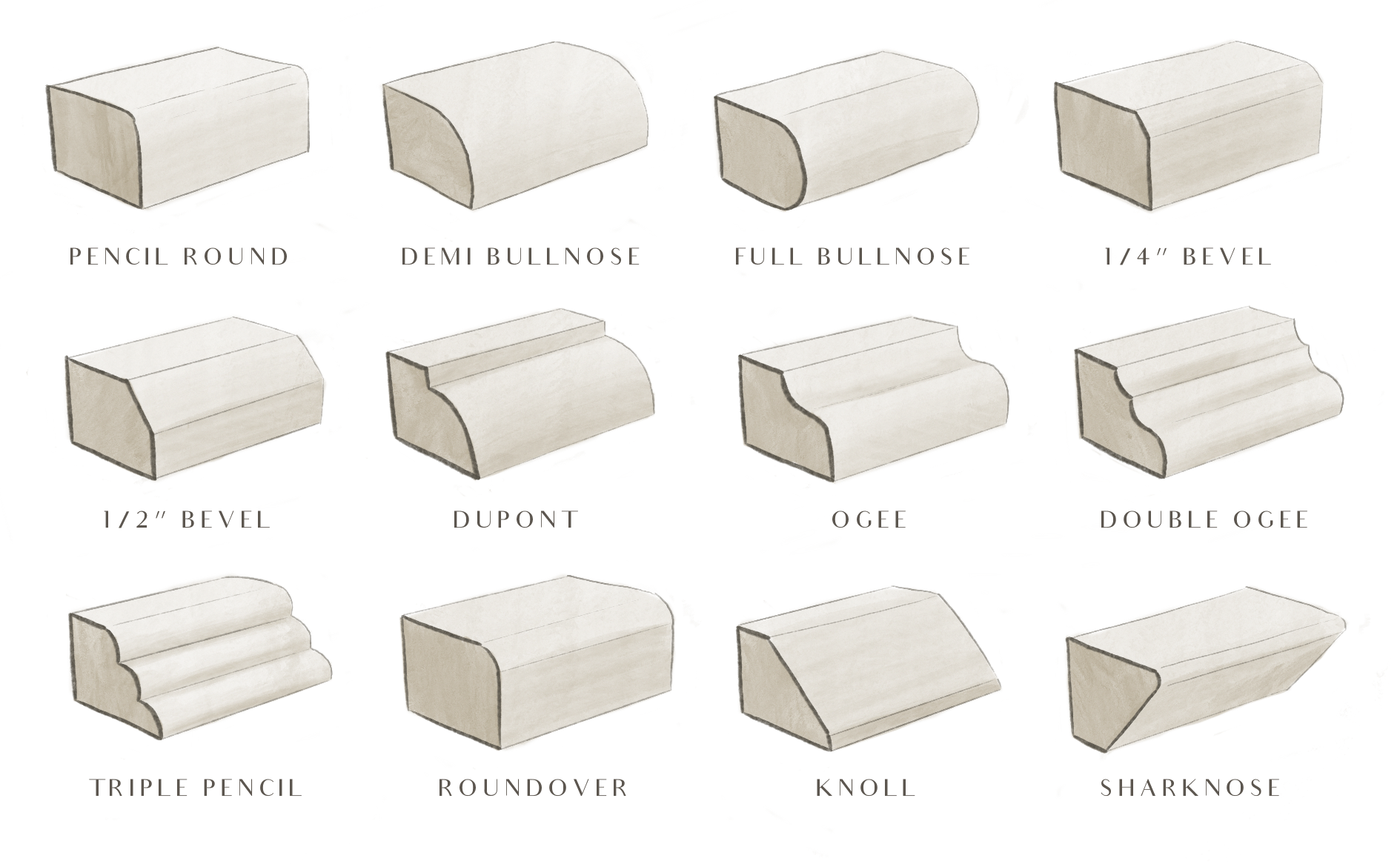
Worktop thickness plays a subtle but important role in the overall aesthetic. Standard thicknesses tend to be 20mm or 30mm, with slimmer profiles creating a more contemporary feel. In some cases, a built-up edge is used to give the appearance of greater thickness without the additional weight.
Edge profiles further refine the look. A simple pencil or eased edge feels clean and modern, while bullnose or bevelled edges introduce a softer, more traditional detail. More decorative profiles can be used in classic schemes, though in most contemporary interiors, restraint tends to produce a more resolved result.
Cost considerations
Costs vary widely depending on material, supplier and level of fabrication required. As a general guide, laminate sits at the lower end, followed by wood. Solid surface materials and granite occupy the mid-range, while quartz and porcelain typically sit at the higher end, particularly when more complex detailing or premium brands are involved. Additional factors such as cut-outs, edge profiles and installation complexity can significantly influence the final cost.
Final considerations
Selecting a worktop is ultimately a balance between performance and character. Highly engineered materials offer ease and consistency, while natural materials bring variation and a sense of authenticity. Neither approach is inherently better; the decision rests on how the kitchen is used and how the client wishes the space to evolve over time. A well-considered choice will feel appropriate not only on completion, but in the years that follow.