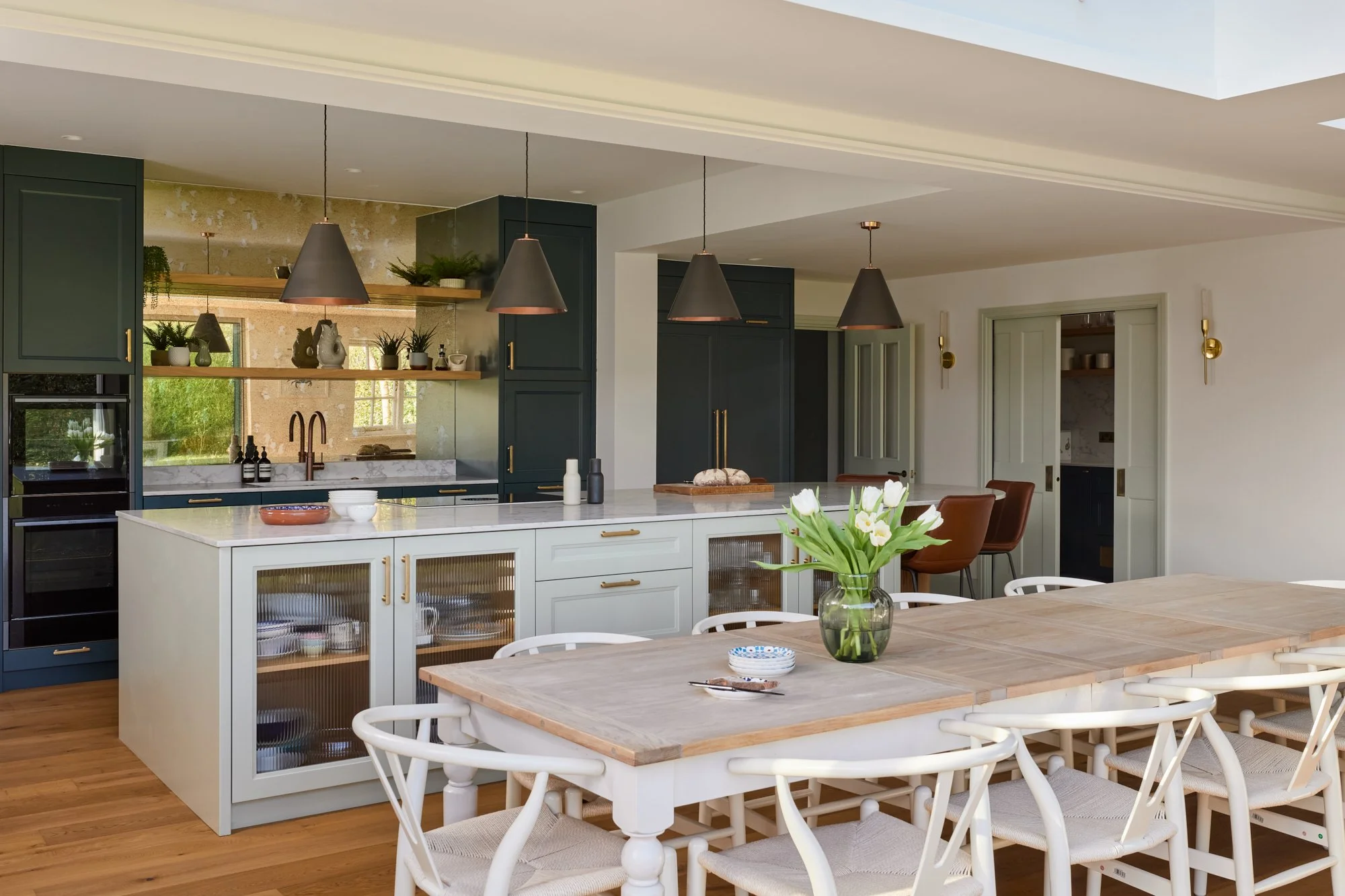
Bespoke Joinery & Kitchens
Craft, process and long-term value
Bespoke joinery sits at the core of a well-resolved interior. Whether in a kitchen, dressing room or fitted living space, it allows each element to be designed in direct response to the architecture, rather than working around standardised components. The result is often quieter and more considered, with proportions, alignments and detailing that feel intentional rather than imposed.
While the visual outcome is important, much of the value in bespoke joinery lies in the process behind it — careful measurement, thoughtful material selection and precise installation.

Custom design versus standard cabinetry
The defining difference between bespoke joinery and off-the-shelf or kit kitchens lies in flexibility. Standard cabinetry is manufactured to fixed dimensions, which means layouts are often adapted to suit the units. This can result in filler panels, awkward gaps or compromised proportions.
Bespoke joinery, by contrast, is designed to the exact dimensions of the space. Cabinet widths, heights and depths can all be adjusted, allowing elements to align cleanly with architectural features such as windows, beams or alcoves. This becomes particularly valuable in older properties or where symmetry and balance are key to the design.
Internally, layouts can also be tailored in a way that standard kitchens cannot accommodate. Storage is designed around how the space will actually be used, rather than relying on pre-determined configurations.

Materials and construction
Most bespoke cabinetry is constructed using a combination of practical internal materials and more refined external finishes. Internally, melamine-faced boards or laminates are typically used for carcasses, sometimes paired with wood veneer where a more elevated internal finish is desired. These materials are durable, easy to clean and stable over time, making them well suited to everyday use.
Externally, the finish can vary depending on the design intent. Veneered boards, such as oak or walnut, offer a natural grain and warmth while maintaining stability. Spray-finished joinery, typically applied to MDF, provides a smooth and consistent painted surface and allows for a wide range of colours. Laminate finishes may also be used externally where a more robust or contemporary finish is required.
Paint matching between joinery and walls is often requested. While spray finishes can be colour-matched to a paint reference, the final appearance will differ slightly due to the application method and surface texture. In most cases the match is very close, but not identical, which is worth noting when aiming for a seamless result.
It is also important to understand the specified materials in detail before manufacture begins. Samples should be reviewed and approved, and joinery drawings carefully checked, including internal configurations. Changes once manufacturing has commenced are often difficult to accommodate and may incur additional costs. Where natural materials such as timber veneers are used, tonal and grain variation should be expected; this is an inherent quality of the material rather than a defect.
Templating and when it happens
Accurate measurement is fundamental to bespoke joinery, and the process is typically carried out in stages. While initial designs are based on survey drawings, final dimensions are always confirmed on site.
Bespoke joinery must be templated in situ. This usually takes place once the walls have been constructed and plastered, and floorboards installed, ensuring that all key surfaces are in their final position. At this stage, precise measurements are taken to allow the joinery to be fabricated accurately.
Any pricing provided prior to templating should be considered indicative. Final costs may adjust slightly once exact site conditions are confirmed. Similarly, designs may need to respond to site realities, such as minor changes in ceiling heights or allowances for boxing around services. These adjustments are a normal part of the process and ensure the joinery fits seamlessly within the space.
The manufacturing lead time begins from the point of templating, rather than from initial design approval, which is an important factor in overall project timelines.
Because of this sequencing, there is often a natural pause between the completion of building works and the installation of joinery. This is a necessary part of achieving a precise fit, rather than an inefficiency.

Fabrication and installation
Once templated, joinery is manufactured off site in a controlled workshop environment. This allows for a high level of precision and finish that is difficult to achieve on site. Fabrication typically takes several weeks, depending on the scale and complexity of the project.
Installation is carried out in situ by the joiners themselves. This stage is relatively efficient, often taking a few days to a couple of weeks depending on the extent of the joinery. For installation to proceed smoothly, the space should be fully prepared, with walls skimmed and final floor finishes in place.
Contractors should allow appropriate access and time for the joiners to complete their work. In some cases, carpets may be installed before the joinery (wall-to-wall) or afterwards, fitted neatly up to the cabinetry. Following installation, there may be some final finishing works required, such as skirting, coving or minor decorating touch-ups, to ensure a fully resolved result.
Longevity and value
Well-designed bespoke joinery tends to have a longer lifespan than standard cabinetry. Because it is built specifically for the space, it is less likely to date or feel compromised over time. The materials used are generally of a higher quality, and the method of construction — carefully measured, fabricated off site and precisely installed — contributes to its durability.
In kitchens, this often translates into cabinetry that continues to function and look appropriate long after trends have shifted. Elements such as doors and finishes can be updated if needed, while the underlying structure remains sound.
While the initial investment is higher than a standard kitchen, the value lies in both performance and longevity. A bespoke approach reduces the need for future alterations, avoids compromises in layout, and results in a more cohesive overall design.
Final considerations
Bespoke joinery is as much about precision as it is about appearance. When carefully designed and executed, it integrates seamlessly into the architecture of a space, rather than sitting within it. The process requires patience — particularly around templating and lead times — but this is what allows the final result to feel resolved, durable and considered in the long term.